Does a good appearance provide an advantage during recruitment or career progression, and what kind of images are associated with different professions? And why is a man likely to only benefit from a good appearance – Professor Outi Sarpila discussed this at Joki Forum.
On average, women spend significantly more time and money on their appearance than men. Yet, there is no guarantee that these investments will pay off. While good looks can be an advantage for a woman in life, they can also be a disadvantage.
Because men spend less time and money on their appearance than women, the investment is always better for them in terms of cost-benefit ratio. A good appearance does not hinder men's success or career.
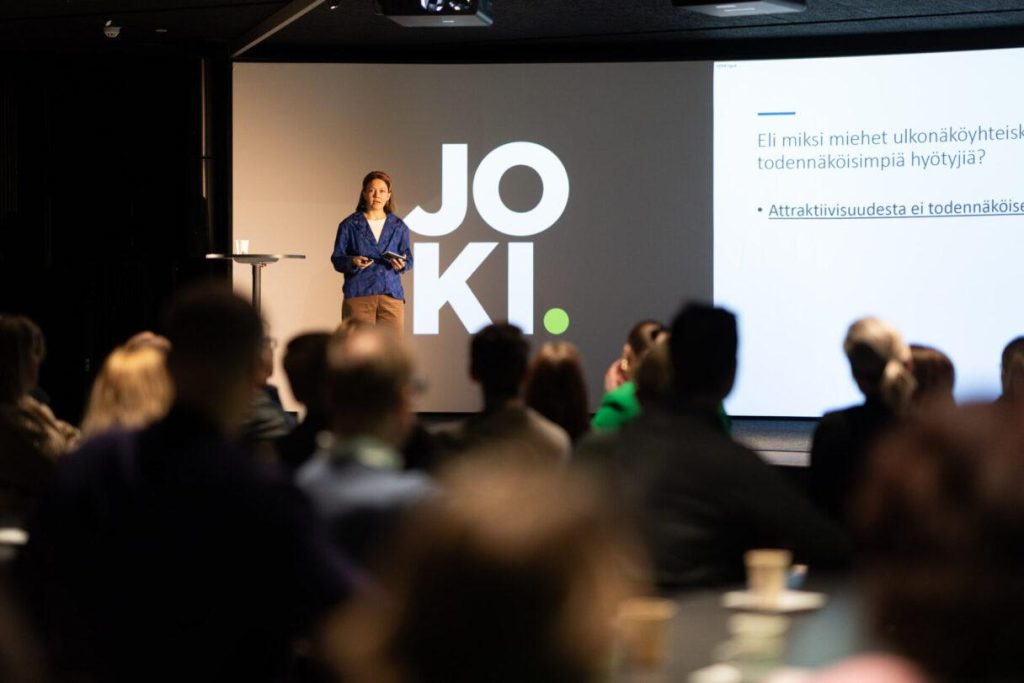
This is how Outi Sarpila, Professor of Sociology at the University of Turku, summarizes it. She spoke about the 'lookism' society at Joki Forum in the spring of 2024. Sarpila has led a research team that has written, among other things, the book Ulkonäköyhteiskunta – Ulkoinen olemus pääomana 2000-luvun Suomessa.
When we talk about appearance, we are not just talking about faces and their attractiveness. Appearance also inherently includes the body, as well as its shape and size, such as height and weight. In addition, hair, beard, clothing, and style influence appearance.
A good appearance has generally been considered something that benefits a person in working life and helps, for example, with career progression. Is this the case – and is the effect the same for both men and women? Sarpila's research set out to challenge this idea, and the results were surprising. According to them, a good appearance can even be a disadvantage for women in working life. In contrast, this phenomenon does not exist for men.
“One could even say that appearance is an uncertain resource for women in working life. The general mindset that you have to be the 'best version of yourself' at work can be harmful to women. It is not necessarily what the working world is looking for,” Sarpila says.
A good appearance can be a disadvantage for a woman as early as the job application stage if the photo in her application is beautiful. In this case, a stereotype can arise, suggesting that a beautiful woman cannot be smart. Style can also cause problems. A good-looking woman who dresses a certain way may be perceived as too sexy for the role – on the other hand, a polished style might be perceived as too formal for a certain position.
”Appearance is an uncertain resource for women in working life.” Outi Sarpila
“According to studies, workplaces search, at least subconsciously, for a person who fits the organization's style and the company's brand. If the applicant's style is different, the conclusion may be that 'they don't fit in with us'.”
The process can also be unconscious, as recruiters can easily say they made their decisions solely based on the applicant's merits and so-called hard skills. Appearance is not necessarily discussed because it is not perceived as a relevant issue – even when it influences the process in the background.
Sarpila challenges us to pay attention to these kinds of attitudes.
“We cannot wash our hands of the matter and say there’s nothing that can be done. Every recruiter is a wielder of power. I challenge everyone to think about what they can do to avoid reinforcing inequality in such situations. According to studies, colleagues also produce and reproduce the organization's appearance culture and, as it were, monitor each other's appearance. The danger is that we produce an appearance culture where there isn’t enough room for different appearances and aesthetic self-expression.”
What kind of appearance is expected from a representative of a certain profession, such as a researcher, teacher, or nurse? Sarpila is currently researching this in a project funded by the Academy of Finland. The goal is to determine whether we have shared perceptions of a so-called profession-consistent appearance, as well as what social and economic consequences profession-consistency and inconsistency have.
The matter is being researched through images of people representing different professions and by using various experimental setups. As part of the research, portraits from the 2017 municipal elections were compared. The comparison examined how gender, social class, and appearance correlate with each other.
The research revealed that if a person clearly belonged to the upper middle class and held a high professional position, looking like a representative of one's own profession was equally beneficial for both men and women. If, on the other hand, a candidate clearly belonged to the working class in their profession but was a man, a working-class appearance was not a disadvantage for him. For a woman, however, it was clearly a disadvantage, and this was reflected in the votes received.
“Politics is a traditionally masculine field, so traditional working-class masculinity fits well with labor parties. Women, on the other hand, are still new in that field. Furthermore, it is known from international studies that a feminine habitus perceived as working-class is particularly despised by the middle and upper classes.”
This research highlighted the same conclusion that arises repeatedly: men receive double or even triple the status from their appearance.
“No matter how you measure it, appearance likely brings the most benefit to men who are already doing well. First of all, they have the status brought by masculinity, success brought by a good profession, and also a good appearance. For a man, a good and culturally appropriate appearance is therefore fundamentally more likely to be beneficial than a similar appearance is for women.”
Sarpila says that the conclusion indicates that the valuation of appearance in society not only deepens gender inequality but also fuels inequality among men.
– New forms of alienation and experiences of exclusion arise when one's own appearance is not felt to be enough in current labor or dating markets. Extreme examples of this are the misogynistic incel communities online.